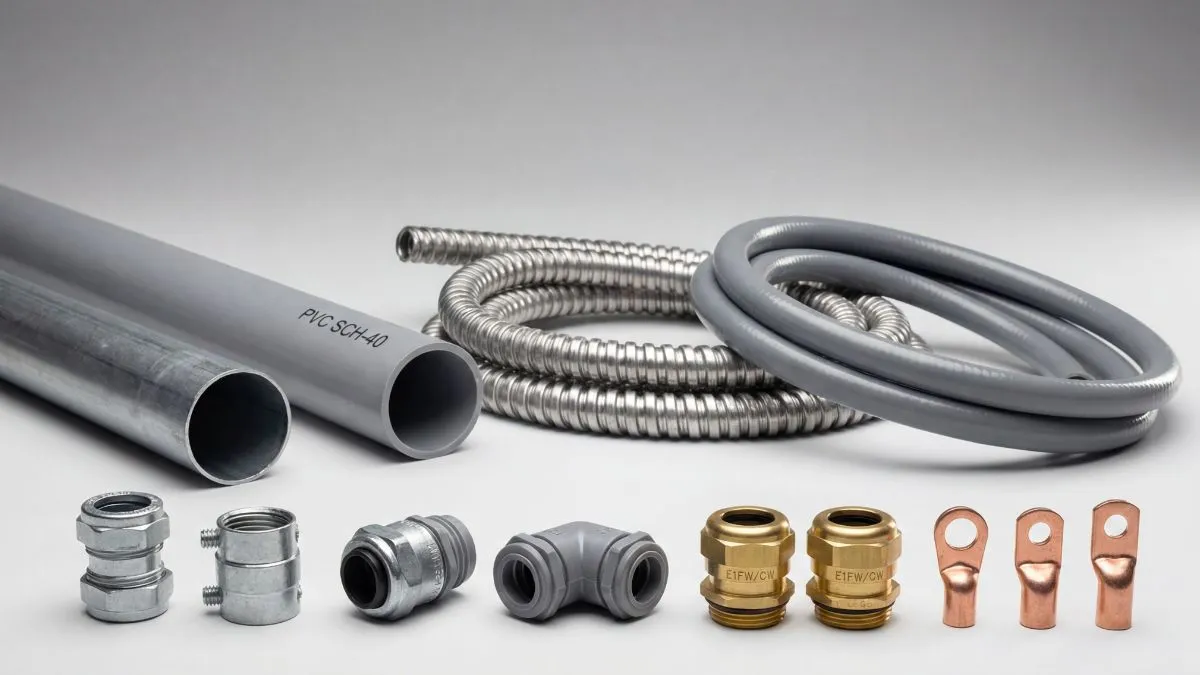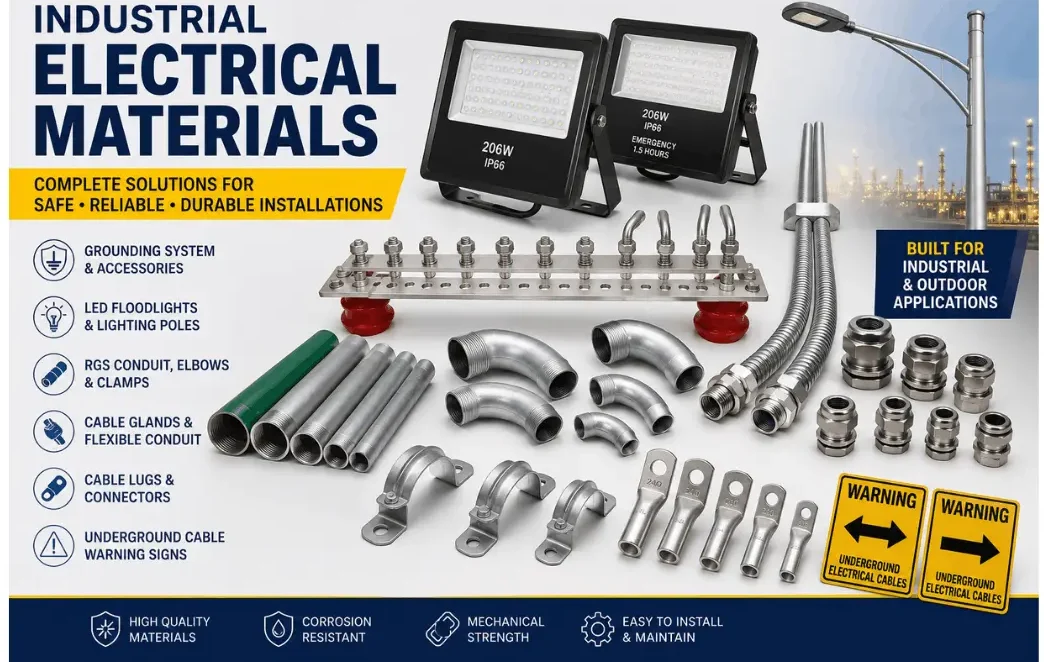
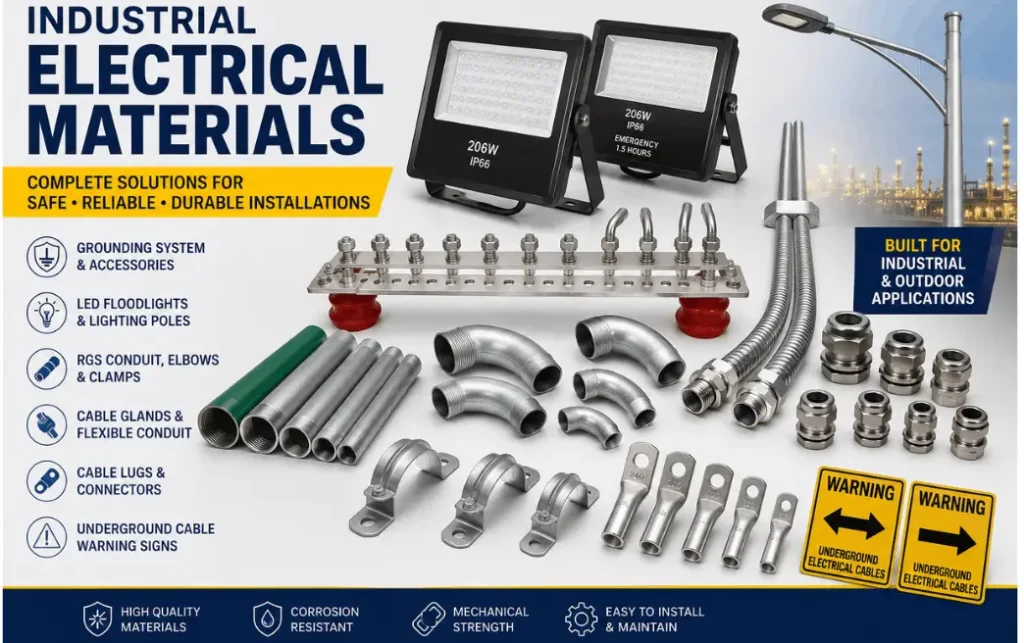
Reliable electrical infrastructure depends on more than cables and power equipment. Grounding systems, outdoor lighting, galvanized conduits, flexible metallic conduit, cable glands, cable lugs, mounting hardware and electrical warning signs all play an important role in creating a safe, durable and professionally engineered installation.
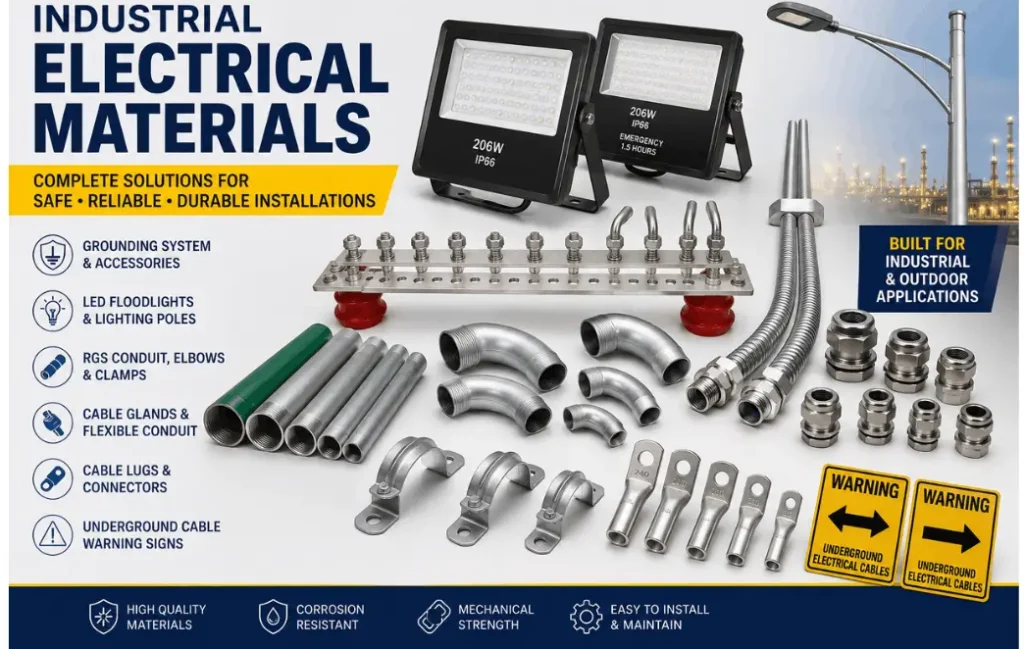
This range of industrial electrical materials is designed for applications where mechanical protection, electrical continuity, environmental resistance and dependable installation are essential. The products described below cover major requirements for grounding and earthing systems, street lighting, outdoor floodlights, rigid conduit systems, flexible conduit connections, cable termination and underground electrical cable identification.
Whether the requirement is for an industrial plant, utility facility, infrastructure project, commercial development or oil and gas installation, selecting the correct specification and compatible accessories is critical to long-term performance.
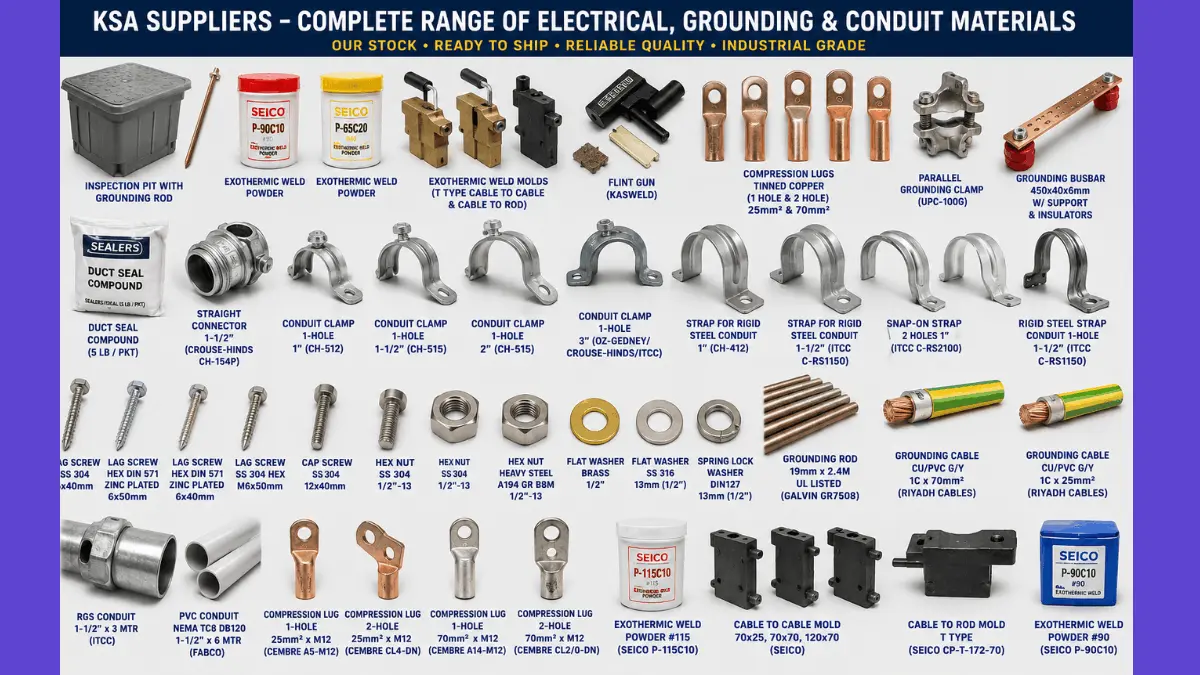
Grounding Busbars
A properly engineered grounding system provides a controlled path for fault current and helps establish electrical potential equalization throughout an installation. Grounding busbars are commonly installed as centralized connection points where grounding conductors, bonding conductors and equipment earthing connections can be organized.
The specified grounding busbar is a 12-way tinned-copper hard-drawn bar with dimensions of approximately 101 mm wide × 508 mm long × 6.5 mm thick. It is supplied with the required connection accessories, mounting insulator and pre-drilled fixing arrangement.
Its two-hole connection pattern and channel-base compatibility make it suitable for organized installation where multiple grounding conductors must be terminated in a controlled and accessible location.
Key grounding busbar features
- 12-way grounding connection arrangement
- Tinned copper construction
- Hard-drawn copper bar
- Approximate dimensions: 101 × 508 × 6.5 mm
- Pre-drilled fixing holes
- Two-hole connection pattern
- Mounting insulator included
- Swan-neck connection accessories included
- Suitable for channel-base installation
- Designed for industrial grounding and bonding applications
Tinned copper is particularly useful where corrosion resistance and reliable electrical contact are important. The complete mounting arrangement also simplifies installation and helps maintain a neat grounding system.
Outdoor LED Floodlight Fixtures
Industrial and infrastructure facilities require lighting that can withstand dust, moisture, weather and continuous outdoor exposure. The specified 206 W LED outdoor floodlight luminaire is designed for pole-mounted applications and carries an IP66 protection rating.
An IP66-rated enclosure provides a high level of protection against dust ingress and powerful water jets, making this type of luminaire appropriate for demanding outdoor environments when correctly installed.
The 230 V, 60 Hz LED fixture can be used for applications such as:
- Industrial yards
- Equipment areas
- Access roads
- Utility areas
- Storage yards
- Facility perimeters
- Outdoor work areas
- Pole-mounted floodlighting systems
GET QUOTE : Email : sales@ksa-suppliers.com
Emergency Battery Backup LED Floodlight
A second configuration incorporates a 1.5-hour emergency battery backup. This provides an additional level of operational continuity where illumination may be required during a loss of normal electrical supply.
Emergency-backed outdoor lighting can be particularly valuable around access routes, operational areas, plant facilities and locations where maintaining visibility during an electrical interruption is important.
10-Metre Hot-Dip Galvanized Street Lighting Pole
The lighting system can be supported using a 10-metre street lighting pole manufactured from hot-dip galvanized steel. The specified arrangement includes lighting arms, base components, anchor bolts and associated installation accessories.
Hot-dip galvanizing provides a protective zinc coating over the steel surface, helping the pole withstand outdoor exposure and atmospheric conditions.
A complete street lighting pole assembly may include:
- 10 m steel pole
- Street lighting arm
- Pole base
- Anchor bolts
- Mounting hardware
- Required installation accessories
The final pole foundation, arm configuration and installation method should be selected according to the project design, structural requirements and applicable specifications.
RGS PVC-Coated Conduit
Rigid galvanized steel conduit, commonly referred to as RGS conduit, provides mechanical protection for electrical conductors and cables. Adding a PVC coating provides an additional protective layer that can be advantageous in environments where corrosion resistance and external protection are important.
The specified PVC-coated RGS conduit is available in several diameters and is supplied in 3.0-metre lengths with NPT threads, in accordance with the stated project requirements.
Available PVC-coated RGS conduit sizes
- 4 inch × 3.0 m
- 2.5 inch × 3.0 m
- 2 inch × 3.0 m
- 1.5 inch × 3.0 m
- 1 inch × 3.0 m
The specification references ANSI C80.1 for the rigid steel conduit requirements.
PVC-coated RGS conduit is useful where electrical cables require robust mechanical protection combined with additional resistance to environmental exposure.
RGS 90-Degree Conduit Elbows
Electrical conduit routes frequently require directional changes. 90-degree RGS conduit elbows allow the conduit system to change direction while maintaining a continuous protected pathway for cables.
The specified elbows include PVC-coated and uncoated RGS configurations in the required sizes.
PVC-coated RGS elbow sizes
- 4 inch
- 2.5 inch
- 2 inch
- 1.5 inch
- 1 inch
RGS elbow sizes
- 1.5 inch
- 1 inch
The specified fittings reference ANSI C80.3, making correct dimensional and threading compatibility an important consideration when matching elbows with conduit.
Using compatible elbows rather than improvised bends helps maintain conduit integrity and provides a more professional installation.
Conduit Clamps
Conduit must be adequately supported to prevent movement, vibration and unnecessary mechanical stress. The specified conduit clamps are strap-type, hole-mounted supports manufactured from malleable iron and finished with a rigid hot-dip galvanized coating.
Available sizes correspond with the specified conduit system:
- 4 inch conduit clamp
- 2.5 inch conduit clamp
- 2 inch conduit clamp
- 1.5 inch conduit clamp
- 1 inch conduit clamp
The correct clamp size should match the outside dimensions and installation requirements of the selected conduit.
Galvanized construction is particularly suitable for industrial installations where the support hardware may be exposed to outdoor or corrosive conditions.
Liquidtight Flexible Metallic Conduit
Rigid conduit is not always suitable for equipment connections where movement, vibration or alignment changes are present. Liquidtight flexible metallic conduit provides a flexible protected pathway between fixed conduit systems and electrical equipment.
The specified flexible metallic conduit is:
- 1.5 m long
- Available in 2 inch, 1.5 inch and 1 inch sizes
- Supplied with connector
- Intended for the stated hazardous-area application
- Suitable for Class I, Zone 2, Group IIA, T3 applications as specified
Flexible conduit should always be selected with connectors that are compatible with the conduit type, enclosure entry and hazardous-area requirements of the project.
Stainless Steel Cable Glands
Cable glands provide a controlled and secure cable entry into electrical equipment, junction boxes, panels and enclosures. For armoured cables, barrier-type glands can provide cable sealing and termination while accommodating the armour arrangement specified by the installation design.
The listed products include stainless steel barrier-type cable glands for armoured and unarmoured cables.
Armoured cable gland configurations
The specified range includes glands for cable sizes using CMP-referenced configurations such as:
- 63SPX2K
- 25PX2K
- 32PX2K
- 25PX2K
- 20PX2K
Unarmoured cable gland configurations
The listed unarmoured cable gland range includes:
- 25PXSS2KREX
- 20PXSS2KREX
- 25SSKGP
- 20SSKGP
Stainless steel construction can be advantageous for demanding industrial environments where mechanical strength and corrosion resistance are important.
When selecting a cable gland, the cable diameter, cable construction, armour type, enclosure entry thread and hazardous-area certification requirements should all be checked before installation.
Tinned Copper Cable Lugs and Connectors
Electrical cable termination is a critical part of any power distribution system. Tinned copper cable lugs provide a conductive interface between cables and electrical equipment such as busbars, terminals and grounding points.
The specified connectors are crimping-type, one-hole, NEMA-style tinned copper lugs for different conductor cross-sectional areas.
Available conductor sizes
- 240 mm²
- 150 mm²
- 120 mm²
- 35 mm²
- 25 mm²
- 16 mm²
The listed specifications reference SAES-P-104, while the 25 mm² item also references SAES-P-105.
Proper lug selection should consider conductor size, material compatibility, palm-hole dimensions, stud size, installation tooling and the applicable project specification.
A correctly crimped cable lug helps provide a reliable electrical and mechanical connection while reducing the risk associated with poor termination practices.
Underground Electrical Cable Warning Signs
Underground electrical systems require clear identification to reduce the risk of accidental damage during excavation and maintenance activities.
The specified warning signs are designed as black-on-yellow pictorial markers for underground electrical cable identification. Two configurations are included:
- Double-pointed arrow warning sign
- Single-pointed arrow warning sign
The signs are approximately 90 mm square and may be manufactured from aluminium or steel, with wall-mounting capability and baked enamel finishing as specified.
The use of clear warning markers can help maintenance personnel and contractors recognize the presence and route of underground electrical infrastructure.
Why Correct Material Selection Matters
Industrial electrical installations are exposed to a wide variety of environmental and operational conditions. A material that appears suitable based only on size may not necessarily meet the complete project requirement.
Before purchasing or installing electrical materials, it is important to verify:
1. Material compatibility
Check whether copper, galvanized steel, stainless steel, PVC-coated steel and other materials are appropriate for the installation environment.
2. Dimensions and sizes
Conduit, elbows, clamps, glands and cable lugs must be dimensionally compatible with the associated equipment and cables.
3. Applicable standards
Project specifications may require compliance with standards such as ANSI, BS, NEMA or Saudi Aramco Engineering Standards. The applicable revision and project requirements should always be confirmed before procurement.
4. Environmental protection
Outdoor and industrial installations may require resistance to water, dust, corrosion, UV exposure, chemicals or mechanical impact.
5. Hazardous-area requirements
Equipment installed in classified locations must be suitable for the exact hazardous-area classification, gas group, temperature class and certification requirements specified by the project.
Complete Electrical Material Supply for Industrial Projects
The combination of grounding busbars, LED lighting, galvanized poles, RGS conduit, conduit elbows, clamps, flexible metallic conduit, cable glands, cable lugs and warning signs represents a broad range of materials commonly required for electrical infrastructure projects.
Supplying compatible materials as a coordinated package can simplify procurement and reduce the possibility of mismatched components. It also allows contractors and project teams to maintain consistency across installation areas.
For procurement teams, engineers and contractors, the most important objective is not simply finding a product with the correct nominal size. The complete specification—including material, finish, connection type, standard, environmental rating, hazardous-area suitability and required accessories—should be considered.
Industrial Electrical Materials in Saudi Arabia
For projects in Saudi Arabia, electrical material procurement often requires close attention to project specifications, approved manufacturers, applicable Saudi standards and client-specific engineering requirements.
Materials such as grounding busbars, RGS conduit, PVC-coated conduit, cable glands, cable lugs, outdoor LED floodlights and galvanized lighting poles are commonly associated with industrial, infrastructure, construction, utility and energy-sector projects.
A professional procurement process should therefore verify the technical specification before issuing a purchase order. Where a manufacturer or approved-equivalent requirement exists, the proposed alternative should be technically evaluated rather than selected solely on price.
Frequently Asked Questions
What is a grounding busbar?
A grounding busbar is a conductive metal bar used as a common connection point for grounding and bonding conductors within an electrical installation. It helps organize multiple grounding connections and provides a common electrical bonding point.
What is RGS conduit?
RGS stands for Rigid Galvanized Steel conduit. It is a heavy-duty metallic conduit used to provide mechanical protection for electrical wiring and cables.
What is PVC-coated RGS conduit used for?
PVC-coated RGS conduit combines the mechanical strength of rigid steel conduit with an external PVC protective coating. It can be selected for installations where additional environmental and corrosion protection is required.
What is the purpose of a 90-degree conduit elbow?
A 90-degree conduit elbow changes the direction of a conduit route while maintaining a protected pathway for electrical conductors and cables.
Why are cable glands used?
Cable glands secure cables where they enter electrical equipment and can provide sealing, strain management and, where applicable, armour termination and bonding.
What is a tinned copper cable lug?
A tinned copper cable lug is a copper termination component with a tin coating. It is crimped onto a conductor to create a connection between the cable and electrical equipment or a busbar.
Why is emergency battery backup used in LED lighting?
Emergency battery backup allows a designated lighting fixture to continue operating for a specified period after normal power is interrupted. In this specification, the emergency backup duration is 1.5 hours.
What does IP66 mean for an outdoor light?
IP66 indicates that the enclosure is designed to provide dust-tight protection and protection against powerful water jets, subject to the applicable test conditions and product certification.
Technical Material Summary
| Material | Main Specification | Typical Application |
|---|---|---|
| Grounding Busbar | 12-way, tinned copper, 101 × 508 × 6.5 mm | Grounding and bonding |
| LED Floodlight | 206 W, 230 V, 60 Hz, IP66 | Outdoor industrial lighting |
| Emergency LED Floodlight | 206 W, 1.5-hour backup, IP66 | Emergency/outdoor lighting |
| Lighting Pole | 10 m, hot-dip galvanized steel | Street and area lighting |
| PVC-Coated RGS Conduit | 1–4 inch, 3 m | Cable protection |
| RGS Conduit | 1–1.5 inch, 3 m | Cable protection |
| 90° RGS Elbow | 1–4 inch range | Conduit direction changes |
| Conduit Clamp | 1–4 inch range | Conduit support |
| Flexible Metallic Conduit | 1–2 inch, 1.5 m | Flexible equipment connections |
| SS Cable Gland | Armoured/unarmoured cable configurations | Cable entry and termination |
| Tinned Copper Lug | 16–240 mm² | Cable termination |
| Warning Sign | 90 mm, black/yellow | Underground cable identification |
Conclusion
A dependable electrical installation requires a complete system of compatible materials rather than isolated components. Grounding busbars establish organized grounding connections, LED luminaires provide outdoor illumination, galvanized poles support lighting systems, RGS conduit protects cables, flexible conduit accommodates equipment movement, cable glands provide controlled cable entry, and tinned copper lugs create dependable electrical terminations.
For industrial and infrastructure projects, every component should be selected according to the required dimensions, material, environmental conditions, electrical characteristics, applicable standards and project specifications.
Choosing the right industrial electrical materials at the procurement stage can improve installation efficiency, support system reliability and help ensure that the finished electrical infrastructure meets the project’s technical requirements.